
Navigating the intricacies of the Australian legal system requires more than just a general understanding of statutes and precedents; it demands mastery over the digital ecosystem where legal information resides. For law students, practitioners, and researchers, the ability to efficiently locate primary and secondary sources is a fundamental competency.
The transition from physical law libraries to sophisticated digital databases has streamlined research, yet it has also introduced a layer of complexity. Mastering Australian legal research involves understanding which platforms offer the most authoritative data, how to leverage Boolean operators for precise results, and how to verify the currency of legislation and case law.
In the rigorous environment of Australian legal education, students often face high-stakes assessments that require pinpoint accuracy. For those navigating complex statutes or case summaries, seeking expert Criminal Law Assignment Help can provide the necessary clarity to bridge the gap between academic theory and practical legal research application.
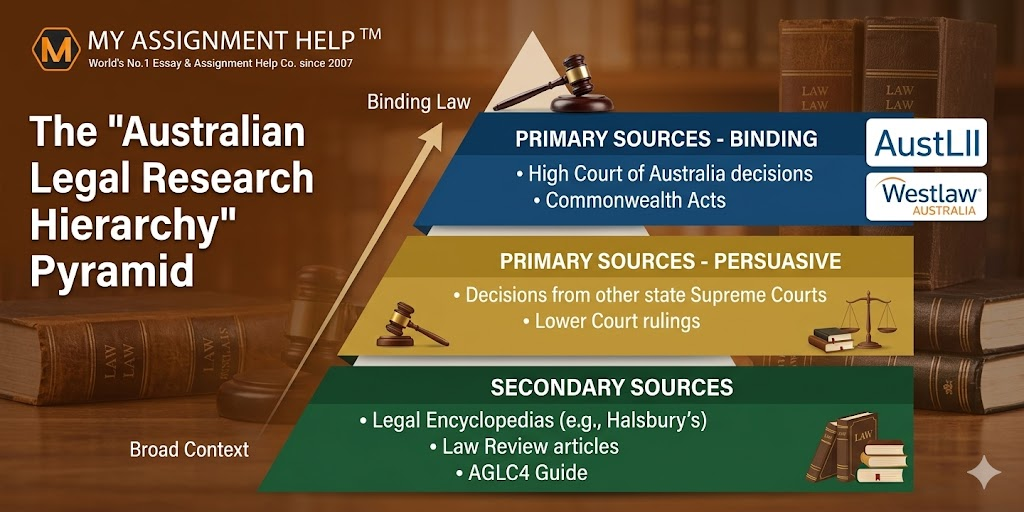
The Pillars of Australian Legal Research: Primary vs. Secondary Sources
Before diving into specific platforms, it is essential to categorize the types of information you will encounter:
- Primary Sources: These include Acts of Parliament (Legislation) and judicial decisions (Case Law).
- Secondary Sources: These assist in interpreting primary sources, including legal encyclopaedias, law journals, textbooks, and dictionaries.
Top Digital Platforms for Australian Legal Research
1. AustLII (Australasian Legal Information Institute)
AustLII is the most significant free-access resource for Australian legal information. It is a joint facility of the UTS and UNSW Faculties of Law.
- Best For: Accessing a vast range of historical and current legislation, regulations, and case law from all Australian jurisdictions.
- Key Feature: The “LawCite” citator, which helps researchers track how a particular case has been treated in subsequent decisions.
2. Federal Register of Legislation
This is the authorized whole-of-government website for Commonwealth legislation and related documents.
- Best For: Finding the most up-to-date versions of Federal Acts and Legislative Instruments.
- Key Feature: The “View Series” function allows you to see the lifecycle of a Bill as it moves through Parliament into an Act.
3. Jade (BarNet)
Jade is a professional current awareness service and legal research platform.
- Best For: Advanced visualizations of citations and “point-in-time” legislative tracking.
- Pro Tip: Use the “Jade Marks” feature to annotate and save specific paragraphs of judgments for later reference.
4. Commercial Databases: Lexis+ and Westlaw Australia
While the above resources are free, academic institutions and law firms rely heavily on paid databases for their superior indexing and secondary commentary.
- Halsbury’s Laws of Australia (Lexis+): An essential legal encyclopaedia that provides a statement of the law on a given topic.
- The Laws of Australia (Westlaw): A rival encyclopaedia known for its comprehensive subject-based organization.
Strategic Research Workflow: A Step-by-Step Approach
Mastery is not just about the tool, but the technique. Follow this workflow to ensure your research meets the highest standards of the Australian legal profession:
Step 1: Define the Scope
Identify whether the matter falls under Federal jurisdiction (e.g., Corporations Law, Family Law) or State jurisdiction (e.g., Property Law, Criminal Law).
Step 2: Search Secondary Sources
Never start with a raw search of cases. Begin with a legal encyclopaedia to understand the “lay of the land.” This provides you with the key terms and seminal cases needed for deeper searches.
Step 3: Locate Legislation
Use the Federal Register of Legislation or State-specific sites (like NSW Legislation or Queensland Legislation) to find the relevant Act. Always check the “Currency” or “In Force” status.
Step 4: Validate with Case Law
Use citators like LawCite or FirstPoint to ensure the case you are citing hasn’t been overturned or significantly distinguished by a higher court.
For students struggling with these technical steps, myassignmenthelp australia offers comprehensive support, ensuring that academic submissions reflect a high level of research proficiency and adherence to Australian Guide to Legal Citation (AGLC) standards.
The Role of AI in Modern Legal Research
Artificial Intelligence is transforming how we interact with legal data. Tools integrated into Westlaw and Lexis+ now allow for “natural language” queries. However, researchers must remain wary of “hallucinations”—where AI generates fake case names or citations. In Australia, the ethical duty of a solicitor to the court means every AI-generated lead must be manually verified through an authorized report.
Data-Driven Insights: Research Trends in Australia
Recent surveys within the Australian legal sector indicate that over 85% of junior lawyers spend more than 10 hours a week on digital research platforms. Furthermore, a shift toward “Open Law” has seen AustLII’s traffic grow by nearly 15% annually, highlighting the increasing reliance on accessible digital infrastructure.
Key Takeaways
- AustLII is the go-to for free, comprehensive cross-jurisdictional data.
- Always verify the currency of legislation via authorized government registers.
- Secondary sources (encyclopaedias) are the best starting point for unfamiliar topics.
- Citators are non-negotiable tools for ensuring case law is still “good law.”
- AGLC4 compliance is the gold standard for citing these digital sources in Australian legal writing.
Frequently Asked Questions (FAQ)
Q: Is AustLII considered an authorized report for court purposes?
A: No. While highly reliable, courts prefer citations from authorized reports (like the CLR or SLR). Use AustLII to find the case, but cite the authorized version if available.
Q: How do I find “Point-in-Time” legislation?
A: Most government legislation websites and JADE offer a history or “View Series” tab that allows you to see how an Act looked on a specific date in the past.
Q: What is the most common mistake in digital legal research?
A: Failing to check if a case has been appealed. Always use a citator to check the subsequent history of a judgment.
Q: Can I use Google for legal research?
A: Google is useful for finding news or general summaries, but it should never be used as a primary source. Always verify information on a dedicated legal database.
Author Bio: Dr. Sarah Jenkins
Senior Academic Consultant at MyAssignmentHelp Dr. Sarah Jenkins holds a PhD in Law and has over 12 years of experience in Australian legal education and digital content strategy. She specializes in helping students navigate the complexities of constitutional and criminal law, focusing on the intersection of legal technology and practical research. As a lead consultant at MyAssignmentHelp, Dr. Jenkins ensures that all academic guidance aligns with the rigorous standards of the Australian legal system and E-E-A-T principles (Experience, Expertise, Authoritativeness, and Trustworthiness).
References
- Australasian Legal Information Institute (AustLII). (2024). austlii.edu.au
- Attorney-General’s Department. (2025). Federal Register of Legislation.
- Melbourne University Law Review Association. (2018). Australian Guide to Legal Citation (4th ed.).
- Rule of Law Institute of Australia. (2024). Digital Accessibility in Legal Research Report