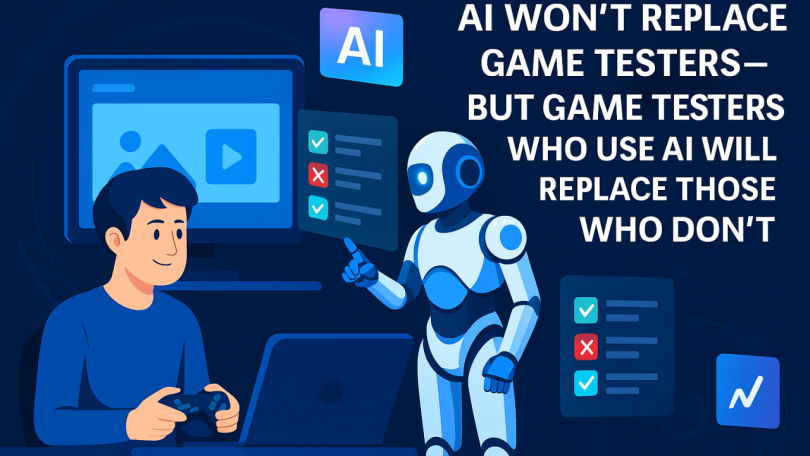

Gaming has evolved from simple pixelated screens to immersive worlds that can rival reality itself. Behind every seamless experience, every perfectly timed animation, and every rewarding game mechanic lies a crucial phase that determines whether a game is enjoyable or frustrating: game testing. But the landscape of game testing is rapidly changing. With advancements in artificial intelligence, the age-old debate is resurfacing—can AI outperform human game testers, or is there an irreplaceable value in human intuition and experience? Today, we explore the strengths and weaknesses of both AI and human game testers, diving deep into the pain points, benefits, and limitations that come with each approach, and examining how this tug-of-war is reshaping the gaming industry.
The Role of Game Testers in Modern Gaming
At its core, game testing is about ensuring the final product is polished, bug-free, and delivers the intended player experience. Human testers meticulously comb through every level, every interaction, and every edge case, often spending hours trying to “break” the game. They don’t just look for technical bugs—they notice whether a level feels unfair, whether a puzzle is confusing, or if a reward system motivates the player. This becomes especially crucial in complex games like slot games or pkv games, where slight miscalculations or glitches can ruin the flow, affect fairness, or even result in financial discrepancies. Humans bring an understanding of psychology, intuition, and creativity that AI still struggles to replicate, making them indispensable when it comes to ensuring a game is fun and engaging for the target audience.
How AI is Revolutionizing Game Testing
AI has emerged as a powerful force in the game development pipeline. With machine learning algorithms and automated testing frameworks, AI can simulate thousands of scenarios in a fraction of the time it would take human testers. This ability to analyze patterns, predict outcomes, and stress-test systems has proven invaluable for large-scale projects. For instance, AI can play a poker game thousands of times per second to detect statistical anomalies or identify unintended exploits. It excels at repetitive tasks, regression testing, and quickly pinpointing glitches in code or mechanics. Moreover, AI systems can operate 24/7 without fatigue, drastically reducing testing timelines and production costs. In fast-paced industries where launch deadlines are tight, this efficiency is a game-changer.
Precision vs. Intuition: Where Humans Shine
Despite AI’s impressive capabilities, humans bring a dimension that machines cannot replicate: intuition. Human game testers can sense when something “feels off,” even if there is no explicit error in the code. They can interpret narrative inconsistencies, emotional responses, or user frustrations in ways that AI cannot. For example, in a qqemas game, while AI may detect a programming bug that prevents a certain combination from appearing, a human tester might notice that the game’s reward frequency feels too frustrating, potentially affecting long-term engagement. The subtlety of human judgment, empathy, and creativity ensures that games are not only functional but also emotionally resonant—a quality AI cannot yet achieve.
Speed vs. Creativity: Where AI Excels
On the flip side, AI’s speed and capacity to handle large-scale testing are unmatched. While a human tester may get fatigued after hours of repetitive gameplay, AI can continuously simulate scenarios, systematically exploring every possible game path. This is especially advantageous in complex systems like multiplayer online games or expansive RPGs, where interactions and outcomes are practically infinite. AI can detect patterns humans might miss, uncover hidden bugs, and generate massive amounts of data that developers can use to refine gameplay mechanics. Furthermore, AI can identify potential exploits or security vulnerabilities in games like poker games, where fairness and accuracy are paramount. This precision and scalability make AI indispensable in modern game testing pipelines.
Pain Points of Human Game Testing
Human testing is far from perfect. It is time-consuming, expensive, and prone to inconsistencies. No two testers will experience a game in exactly the same way, which can result in subjective feedback that developers must reconcile. Fatigue, boredom, and human error can lead to missed bugs or overlooked issues, and repetitive testing can diminish a tester’s attention to detail. Additionally, scaling human testing to accommodate large, complex games can be logistically challenging. Hiring enough skilled testers to cover every scenario can strain budgets and timelines, making it difficult to maintain both quality and speed simultaneously.
Pain Points of AI Game Testing
While AI offers speed and scalability, it is not without limitations. AI lacks creativity, intuition, and emotional intelligence, which are critical for evaluating user experience. It can identify glitches or statistical anomalies but cannot determine whether a level is genuinely enjoyable or whether a storyline resonates with players. AI systems are also dependent on the quality of the data and algorithms feeding them; poorly trained AI may overlook bugs or fail to test unconventional scenarios. Moreover, setting up AI testing frameworks requires significant upfront investment in technology, expertise, and maintenance. In essence, while AI can do the heavy lifting, it cannot replace the nuanced insights of human testers entirely.
Hybrid Approaches: The Best of Both Worlds
The debate doesn’t have to be an either/or scenario. Many developers are now adopting hybrid testing strategies, combining the strengths of AI with the insight of human testers. AI can handle repetitive, large-scale testing tasks, stress-testing game systems, and identifying obvious bugs, freeing human testers to focus on creative, subjective, and nuanced aspects of gameplay. For instance, in a slot game, AI can verify the mathematical fairness of every spin outcome, while human testers evaluate the overall fun factor, excitement, and engagement level of the experience. This symbiotic approach leverages speed and precision without sacrificing the emotional and psychological dimensions of gaming.
Cost Considerations: Budgeting for Quality
Budget plays a crucial role in determining the right mix of AI and human testers. Hiring a large team of human testers can be expensive, especially for long-term projects or frequent updates. AI testing, while requiring initial investment in development and setup, can reduce long-term labor costs and speed up release cycles. However, relying solely on AI might compromise user experience, leading to lower engagement and revenue. Developers must carefully balance cost, quality, and time to market. Hybrid models often offer the most efficient return on investment, ensuring games are both bug-free and enjoyable.
Impact on Game Quality and Player Experience
Ultimately, the goal of game testing is to deliver a polished, engaging, and immersive experience to players. Human testers excel at understanding player psychology, crafting enjoyable experiences, and identifying potential frustrations, while AI excels at eliminating errors and ensuring consistent mechanics. For games like poker games or slot games, where fairness, randomness, and engagement are critical, combining AI precision with human intuition ensures both technical accuracy and user satisfaction. Ignoring one approach in favor of the other risks either technical flaws or a poor gameplay experience.
The Future of Game Testing
Looking forward, the future of game testing is likely to be increasingly collaborative. AI will continue to evolve, becoming more sophisticated in simulating player behavior and predicting outcomes, while human testers will focus more on creativity, emotional response, and game feel. We may even see AI tools that augment human intuition, providing suggestions or identifying subtle issues that humans can then interpret contextually. This partnership could lead to faster, cheaper, and more enjoyable games that push the boundaries of interactive entertainment.
Conclusion: Who Wins the Battle?
So, who is better—AI or human game testers? The answer isn’t straightforward because it depends on what aspect of testing you value most. If you prioritize speed, scalability, and error detection, AI takes the lead. If you value creativity, emotional resonance, and nuanced judgment, humans remain unmatched. However, the real magic happens when both are combined, leveraging AI’s efficiency and humans’ intuition. In today’s competitive gaming landscape, the most successful developers understand that the future lies not in replacing humans with AI, but in enhancing human capabilities with AI to create games that are technically flawless, emotionally engaging, and endlessly enjoyable.