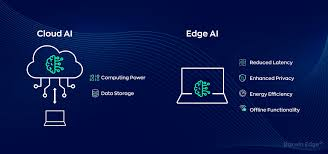

Most AI work used to be done in the cloud. A device sent data away, and a server sent back the result. This still happens, but not always. Now, more AI runs on the device itself or close to it. This is called the edge. Industry sources now describe AI as becoming more distributed across cloud, edge, and local systems rather than living in one place.
Privacy Is The Other Major Part Of The Story
The privacy side is just as important. When data stays on the device, there is less need to send raw information across the internet or store it elsewhere. That does not make edge AI automatically private or risk-free, but it can reduce exposure in a meaningful way.
This is one reason local AI is often described as attractive for sensitive work. NVIDIA says running models on your own hardware can offer complete privacy and zero network latency. Microsoft has also framed on-device AI as important in enterprise security conversations, while Arm has tied on-device processing to both speed and privacy in recent discussions of consumer and industrial use.
Privacy Does Not Mean “No Risk”
It would be a mistake to think edge AI solves every privacy problem. Local processing can reduce data transfer, but the device still has to be secured. The model still has to be monitored. The outputs still need governance. NIST’s recent work on AI monitoring highlights that deployed AI systems create ongoing challenges after launch, including repeated calls for stronger monitoring and better understanding of real-world risks.
The real privacy gain is simple. Less data moves around. There are fewer chances for it to be intercepted. You also have more control over where it is processed. This is useful, especially when you don’t need the cloud while playing at a casino online.
The Cloud Is Not Going Away
Sometimes people talk about edge AI as if it will replace the cloud. That is not likely. The cloud is still better for heavy training, large-scale coordination, shared data pipelines, and bigger models that do not fit well on local hardware. Arm’s recent material makes this clear too: the cloud remains vital, even as more inference moves outward into devices.
What is changing is the split. Training may stay centralized, while inference gets distributed. A large model may live in the cloud, while smaller versions or selected tasks run locally. In practice, the future looks more hybrid than dramatic.
Better Hardware Is Driving The Change
Edge AI is growing partly because hardware has improved. Devices now have more specialized AI acceleration, better performance per watt, and stronger support for compact models. Microsoft’s Foundry Local announcement, Arm’s recent edge messaging, and NVIDIA’s Jetson work all point to the same trend: local inference is becoming more practical because the hardware and software stack are finally catching up.
That matters because edge AI used to be limited by weak local compute. Now, smaller language models, optimized vision models, and quantized systems can run in places that once seemed too constrained. The result is not magic. It is simply that more tasks now fit on local hardware than before.
The Real Change Is About Choice
The biggest shift may not be technical at all. It is architectural. Teams are starting to ask a different question. Not “Can AI run in the cloud?” but “What should run in the cloud and what should stay close to the user?” That helps with speed, cost, reliability, and privacy.
Some tasks clearly belong at the edge. Others clearly belong in the cloud. Many will land somewhere in between. As systems become more distributed, the best design will usually come from matching the job to the right location rather than forcing everything into one model.