
In today’s fast-moving digital world, blockchain is one of the most talked-about technologies. But many people still wonder: how blockchain works?
Let’s break it down in a simple, human-friendly way—like you and I are just chatting over tea. No complex jargon, just clear explanations with examples, comparisons, and tables.
📖 What is Blockchain?
At its core, blockchain is a digital ledger—just like a notebook where you record transactions. But instead of being held by one person, it’s shared across a network of computers around the world. Once a transaction is recorded, it can’t be changed, erased, or faked. This is why blockchain is so powerful for security and trust.
🔗 Key Elements of Blockchain
| Element | Meaning | Analogy |
| Block | Group of transactions | A page in a notebook |
| Chain | Linked blocks | Pages bound together |
| Hash | Unique ID for data | Fingerprint |
| Node | A participant in the network | A copy-holder of the notebook |
| Distributed Ledger | Everyone has the same notebook | Shared notebook |
| Consensus Mechanism | Agreement among nodes | Group voting on truth |
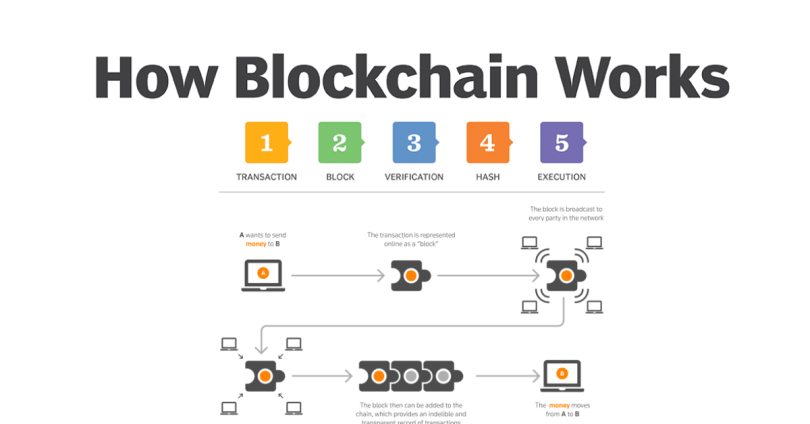
⚙️ Step-by-Step: How Blockchain Works
Let’s walk through what happens when someone sends digital money using a blockchain network like Bitcoin.
Step 1: A Transaction Is Created
Example: You send 1 BTC to your friend. Your wallet creates a transaction request and sends it to the blockchain network.
Step 2: Broadcast to the Network
The transaction is broadcast to many computers (called nodes) in the network.
Step 3: Validation
The nodes verify:
- Do you really own 1 BTC?
- Has it already been spent?
If valid, the transaction is approved.
Step 4: Added to a Block
Once a set of transactions is verified, they are grouped into a block.
Step 5: Proof and Consensus
Depending on the blockchain, different consensus mechanisms are used to validate the block:
| Consensus Type | How it Works | Used In |
| Proof of Work (PoW) | Miners solve difficult math puzzles | Bitcoin |
| Proof of Stake (PoS) | Validators are chosen based on how many coins they stake | Ethereum 2.0 |
| Delegated Proof of Stake (DPoS) | Voting system among stakeholders | EOS |
Step 6: The Block is Added to the Chain
Each block contains:
- Transactions
- Its own hash
- The hash of the previous block (to link it)
This forms the chain.
Step 7: Ledger Is Updated Everywhere
Once added, the new block is shared with every participant (node), so everyone’s ledger is updated at the same time.
📦 Real-World Example: Sending Money
| Action | What Happens on the Blockchain |
| You send 1 BTC | Transaction created |
| Nodes verify it | Check your balance |
| It goes into a block | Collected with other transactions |
| Miners validate the block | Solve math problems |
| Block added to chain | Securely stored forever |
| Everyone sees it | Ledger is synced globally |
You may also like to read these posts:
https://techloomz.com/wp-admin/post.php?post=184&action=edit
https://techloomz.com/wp-admin/post.php?post=186&action=edit
https://techloomz.com/wp-admin/post.php?post=188&action=edit
https://techloomz.com/wp-admin/post.php?post=54&action=edit
✅ Benefits of Blockchain Technology
| Benefit | Explanation |
| Security | Once data is added, it’s extremely hard to tamper with |
| Transparency | Anyone can verify transactions (especially in public blockchains) |
| No middlemen | Peer-to-peer transactions reduce costs |
| Decentralized | Not controlled by one central authority |
| Efficiency | Smart contracts can automate tasks |
❌ Drawbacks of Blockchain
| Drawback | Explanation |
| Scalability Issues | Blockchains like Bitcoin handle fewer transactions per second than banks |
| Energy Consumption | PoW systems consume a lot of electricity (like Bitcoin mining) |
| Complexity | Not easy for beginners to understand or implement |
| Regulation Challenges | Governments are still trying to figure out how to regulate blockchain |
| Immutability can be a problem | Mistakes are hard to fix once data is recorded |
🛠 Blockchain Use Cases (Beyond Cryptocurrency)
| Industry | Use Case | How Blockchain Helps |
| Finance | Cross-border payments | Fast, low-cost, secure transactions |
| Healthcare | Patient records | Secure sharing of medical data |
| Supply Chain | Product tracking | Track origin and journey of goods |
| Voting | Online voting systems | Transparent and tamper-proof elections |
| Real Estate | Property records | Prevent fraud and enable instant ownership transfer |
🧩 Final Thoughts on How Blockchain Works
Understanding how blockchain works doesn’t have to be confusing. It’s a digital system of recording, verifying, and securing data that removes the need for a middleman and keeps everything transparent and safe.
Blockchain is already transforming finance, healthcare, supply chains, and more—and it’s just getting started. By grasping how it works today, you’re preparing for a future where blockchain might become as common as the internet itself.
📌 FAQs
❓ Q1: What is a blockchain in simple words?
Answer: A blockchain is like a digital notebook that records information (like transactions), and once something is written in it, no one can erase or change it. Everyone in the network has a copy of the notebook, which makes it secure and transparent.
❓ Q2: How is blockchain different from a normal database?
Answer: A traditional database is usually controlled by one organization, and the data can be changed or deleted. A blockchain is decentralized, meaning no single person controls it, and once data is added, it can’t be changed.
❓ Q3: Can blockchain be hacked?
Answer: Hacking a blockchain is extremely difficult. To do so, someone would need to control more than 50% of the computers in the network and change all the data at once, which is nearly impossible in large blockchains like Bitcoin or Ethereum.
❓ Q4: What is a block in blockchain?
Answer: A block is a container that holds a group of verified transactions. Once a block is full, it gets added to the chain (blockchain) with a unique code called a hash.
❓ Q5: What is a hash in blockchain?
Answer: A hash is like a digital fingerprint for each block. It ensures the block’s data hasn’t been tampered with. If someone tries to change anything, the hash will change and alert the network.